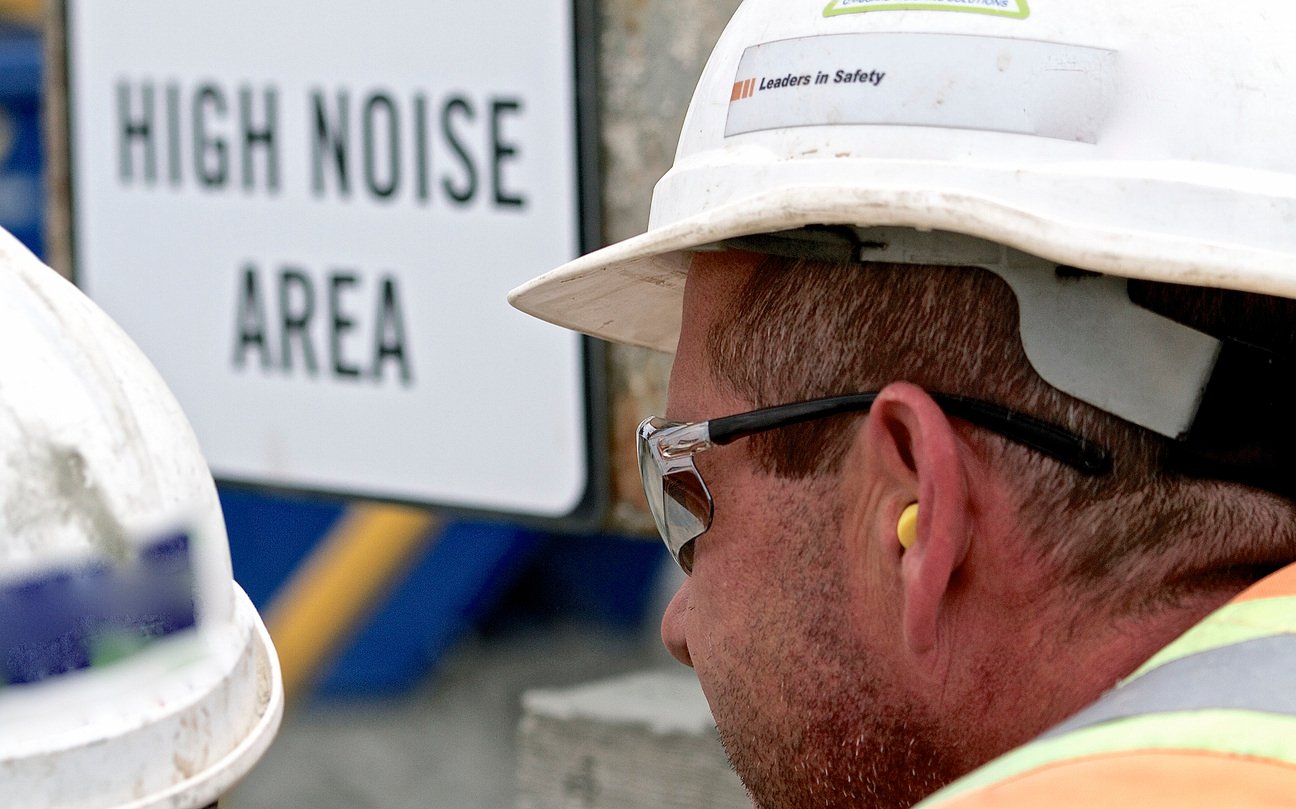
On many American worksites — whether construction zones, infrastructure upgrades, mining operations, utilities or demolition projects — one of the most insidious hazards is excessive noise exposure. Long-term or intense exposure to loud noise not only causes irreversible hearing loss, but it also increases stress, reduces cognitive ability, and raises risk of accidents. Addressing noise is therefore not just a matter of regulatory compliance; it is a core component of worker safety and site-culture.
In this blog, we’ll explore why noise matters, how the regulatory landscape in the U.S. frames employer duties, and how incorporating a solution like Echo Barrier’s acoustic barriers can become a central part of a worksite safety strategy to protect American workers from excessive noise.
Why noise on the worksite must be treated as a safety hazard
Hearing damage and broader health impacts
• According to Occupational Safety and Health Administration (OSHA), “hazardous noise is one of the most common occupational hazards in American workplaces.”
• Chronic exposure to high noise levels leads to noise-induced hearing loss (NIHL) — either gradually over years or in some cases from sudden extreme noise.
• The effects extend beyond hearing: excessive noise can impair communication, raise worker stress and fatigue, reduce vigilance, and even contribute to accidents when warnings are missed or distractions increase.
• Every reduction in sound level helps. Engineering guidance underscores that even a few decibels reduction significantly lowers risk of hearing damage and improves communication.
Regulatory backdrop in the U.S.
• Under 29 CFR 1910.95, when noise exceeds certain levels, employers must implement feasible engineering or administrative controls — and if those fail, provide hearing protection.
• The regulation sets that when employees are exposed to noise exposures equal to or greater than an 8-hour time-weighted average of 85 dB(A), a hearing conservation program must be in use.
• According to OSHA’s “Exposure & Controls” guidance: placing a barrier between the noise source and the worker (i.e., sound walls or curtains) is cited as a valid engineering control.
Thus, from a safety-program perspective, controlling noise is not optional. It is a required part of hazard management and aligns with best practices (and liability avoidance) for American employers.
Role of acoustic barriers in the noise-control hierarchy
In the hierarchy of noise controls, the order of preference is typically: (1) elimination or substitution of the noise source → (2) engineering controls (treat source, path, or receiver) → (3) administrative controls (limit exposure time, move workers) → (4) hearing protection.
Acoustic barriers fall into the engineering-control bucket — they treat the path between the source and worker by absorbing and/or blocking sound energy, thereby reducing the decibels that workers receive. This is preferable to relying purely on hearing protection or administrative controls.
Why Noise Control Improves On-Site Communication
Effective communication is fundamental to worksite safety, yet excessive noise is one of the biggest obstacles to workers hearing instructions, alerts, or warnings. When noise levels rise, teams naturally begin shouting or repeating themselves, which slows work and increases the odds of misunderstandings. While ear defenders are essential personal protective equipment, they can also reduce situational awareness by muffling important sounds, making it harder for workers to communicate clearly with one another. In high-noise environments, this can actually increase risk. By using engineering controls such as acoustic barriers to lower ambient noise, workers can hear speech more naturally, respond faster, and maintain better awareness of moving equipment and hazards. Noise reduction at the source supports clearer communication, safer decision-making, and more efficient teamwork than relying on ear defenders alone.
Key advantages of high-quality temporary acoustic barriers include:
• They reduce the noise exposure footprint so that fewer workers may require hearing protection or may be exposed above action-levels.
• They improve communication and safety by lowering ambient noise, making warnings, alarms and communication easier.
• They support community relations by reducing noise spill-over outside the site, which can reduce complaints — relevant when worksites are near residences.
• They allow greater flexibility in site layout (e.g., locating noisy equipment closer to work-zones with less overall risk).
Given this, a solution like Echo Barrier’s acoustic barrier system becomes a tangible component of a worksite safety plan — especially on projects in the U.S. where regulatory and best-practice pressure is increasing.
How Echo Barrier fits into a U.S. worksite-safety plan - Why Echo Barrier
• Echo Barrier temporary acoustic barriers are world class solutions designed for worksites, tested to reduce noise energy by up to 43 dB.
• The Barriers are weather-proof, fire-resistant, portable and designed for rapid deployment around worksites (construction, demolition, mining, utilities) — making them a practical engineering control rather than a theoretical option.
• Because they are modular and temporary and can be moved without machinery, they align well with changing site layouts and dynamic project schedules common in U.S. construction and infrastructure works.
Where in the safety plan do Echo Barriers apply
• Pre-start hazard assessment: When planning a noisy task (e.g., demolition, drilling, generator use), include acoustic barrier placement in the hazard analysis.
• Engineering control implementation: Rather than rely solely on hearing protection, install Echo Barrier around the noise-source or between the source and worker/occupied areas to reduce exposure.
• Administrative controls enablement: With lower ambient noise, you may be able to expand worker access or reduce separation distances safely — but always in tandem with measurement and verification.
• Hearing conservation program link-up: Because U.S. regulations require monitoring when exposures reach 85 dB(A) averaged, barrier use can help keep exposures below that threshold — reducing the costs and administrative burden of audiometric testing, hearing protection programs, etc.
• Community and site-logistics benefits: Reduced noise spill-over helps maintain better relations with neighbors, allows possible evening or early work with less disruption, and demonstrates company commitment to worker‐ and community-safety.
Practical installation tips
• Place the barrier as close to the noise source as feasible; the closer you treat the source or the path, the more effective the reduction.
• Ensure the barrier is placed as continuous as possible (minimize gaps). Leaks around the barrier reduce effectiveness.
• Consider doubling or layering when the noise source is very intense or near-field. Some studies note the benefit of “double layering hot-spots”.
• Use portable, mobile barrier systems where tasks relocate frequently — the Echo Barrier systems are designed for such flexibility.
• Monitor and measure ambient noise before and after barrier installation to document the benefit and verify your control is sufficient.
• Combine barrier deployment with other controls as needed: e.g., maintenance of noisy equipment, scheduling loud operations when fewer workers are nearby, worker rotation, hearing protection when residual exposures remain.Key Messages to
Why noise matters
• Noise is not simply a nuisance — it is a health and safety hazard. The cost of ignoring it includes hearing loss, lower productivity, increased accidents, regulatory attention and reputational damage.
• U.S. regulations (OSHA) mandate engineering or administrative controls when exposures exceed established limits; simply relying on hearing protection is not sufficient.
• High-quality temporary acoustic barriers, such as Echo Barrier’s product line, provide a practical engineering control for reducing sound energy at worksites.
• Incorporating acoustic barrier solutions into your site’s noise-control plan advances worker protection, supports compliance, and often delivers wider logistic and community-relations benefits.
• Measurement and verification remain critical: deploy the barrier, measure effect, adjust as necessary, and document for your Safety & Health management system.
Conclusion
For contractors, site managers and safety professionals operating in the United States, addressing noise must be an integral part of the worksite safety strategy. By combining regulatory awareness (such as 29 CFR 1910.95) with proactive engineering controls like Echo Barrier acoustic barriers, you can deliver safer working conditions, protect your workforce, meet compliance expectations, and strengthen overall site-culture.
For more information or to get a quote for your project please ring 800 728 9098